Best Practices for Packaging and Storing Homemade Backpacking Food
The main job of a food storage bag is to prevent moisture and air from permeating the contents inside. Standard household freezer bags are readily available and inexpensive, making them appealing for storing homemade dry foods or repacking commercial backpacking food to reduce space. Storing dry food long-term in non-barrier packaging like plastic freezer bags will allow oxygen and moisture from the surrounding air to absorb into the food, where bacterial contamination and growth can occur. Eventually, the food will become soggy and mold. If this happens, the food will be unsafe to eat. Freezer bags will work okay for storing homemade dry foods short term, up to 3 weeks. Beyond that, we recommend using food-grade packaging or rigid containers with barrier-proof properties, such as mylar, metalized bags, glass jars, or sealed containers.
In short, use freezer bags for short-term storage (up to 3 weeks), and choose barrier-proof packaging for long-term storage to keep your food fresh.
Quart-sized plastic zipper bags are a good size for holding individual meal servings or trail snacks for immediate use (less than 1 month storage). Freezer bags are thicker than standard non-freezer bags, making them less likely to puncture during transport.
Use a large bag to prevent smaller plastic zipper bags from ripping when packing gear or stuffing in a bear canister. We recommend the LOKSAK OPSAK because it’s rugged, barrier-proof, and odor-proof.
Barrier-proof bags for longer-term storage
If you are storing backpacking food longer than 3 weeks or so, you’ll need food packaging made of barrier films to prevent or slow down the passing of oxygen and moisture through food packaging. Air is roughly 21% oxygen, which oxidizes many of the compounds in food and allows for the growth of insects, bacteria, and mold.
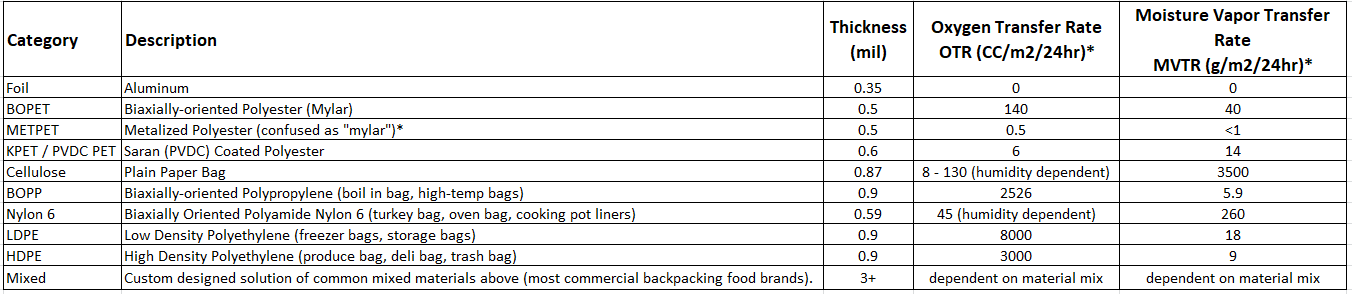
Bags use film, a transparent, thin layer of various materials, including plastics, foil, and paper. Films have different oxygen transfer rates (OTR), which is the amount of oxygen that passes through a defined area of film over 24 hours. Film also has a moisture vapor transfer rate (MVTR), which represents humidity or moisture transfer from the air. The lower this number, the better the barrier. Aluminum offers the best protection against oxygen and moisture with an OTR of 0, while LLDPE (standard freezer bags and zipper storage bags) allows the most oxygen to pass through.
Food packaging contains protective barriers to protect the contents from outside elements such as moisture, UV light, oxygen, insects, and odors. Most backpacking food pouches have multiple layers of specialized film designed to resist punctures, keep contents dry, and handle heat. Photo from vacuumsealersunlimited.com
Adding oxygen absorbers will increase shelf life even further; however, they are likely unnecessary if you squeeze out as much air as possible when closing the bag, store it properly, and consume the food within a year. If you do use oxygen absorber packets, use them only with products low in moisture (10 percent or less). Botulism poisoning can occur when a high-moisture food is stored in a low-oxygen environment.
Oxygen and Water Vapor Barrier Rates of Common Food Packaging Films
A material or package is considered high-barrier when its OTR is less than 15.5 cc/m2/24hr. Besides aluminum foil, mylar (BoPET), metalized polyester (METPET), and coated polyester (KPET) are also good choices for storing dried foods because of their high-barrier characteristics.
Table data source DuPont Teijin * OTR measured at 100% oxygen at 25°C 45% Relative Humidity (RH) in cc/m2/24hr, representing a typical storage atmosphere in populated areas. MVTR measured at 38°C, 90% RH g/m2/24 hours. * Metalized Polyester vs. Mylar. Mylar is a registered trademark owned by DuPont for the chemical composition known as biaxially-oriented polyester (PET), a transparent plastic film. The shiny, silver-colored packaging the general public calls “mylar” is actually a coating of aluminum bonded to polyester plastic—the correct term is metalized polyester.
Pouch Thickness
Generally, the thicker the material, the higher the barrier. Pouch thickness is most commonly measured in Mils. A Mil should not be confused with a millimeter (metric).
1 Mil = .001 inch (1/1000th of an inch)
1 Micron (u) = .04 Mil
A typical sandwich storage bag is 1.5 Mil, whereas a typical freezer bag is 2 to 3 Mil thick.
A standard commercial backpacking food pouch ranges from 4 to 6 mil thick.
Are freezer storage bags safe for “cooking” backpacking food?
It depends on the film thickness and material mix. A typical zipper storage bag made of low-density polyethylene (LLDPE) between 1 and 1.5 mil thick will soften as low as 149°F (65°C), whereas a thicker freezer bag won’t soften at 200°F. Keep in mind that freezer bags are better suited for storing frozen foods. They aren’t designed to hold hot foods or liquids above 170 to 190°F (77 to 88°C).[2] As a result, if you pour boiling water (212°F/100 °C) into these bags to rehydrate your dried meal, the plastic may break down, and the seals can burst and leak. This can create a mess and/or cause microplastics, food dyes, and other substances to migrate into your food. In addition, flat storage bags without gusseted bottoms are awkward to keep upright while pouring and scooping out food. Instead of using freezer bags, we recommend using heat-safe gusseted pouches. Other options include multi-layer mylar cooking pouches, retort pouches, silicone bags, and cook-in-bags. Look for bags labeled as suitable for boiling water or high-temperature food preparation. Brands like Outdoor Herbivore, Packit Gourmet, and Stasher carry products safe for hot water use and are more reliable choices for trail cooking.
While freezer bags and storage bags are meant for storage, many hikers will still use them to heat food. If you do, we recommend letting the boiling water cool for a minute before pouring it into the bag. For food safety purposes, as long as you are reheating dry precooked food to an internal temperature of 165 F, which is hot enough to kill microbes, it should be OK to consume.[3] When reconstituting the food, stir the food thoroughly to ensure uniform heating to prevent cold spots. An insulated cozywill help maintain heat in cold weather.
An insulated cozy can keep backpacking food hot in cold, windy conditions or at higher elevations, where meals can become crunchy from underheating.
Glass mason jars offer excellent oxygen and moisture barrier and are reusable. You can repurpose pickle jars, pasta sauce jars, salsa bottles, and other jars to store your dried food at home. However, you’ll need to transfer them to a bag before you hit the trail. “Greener” bags might work for short-term backpacking food storage, but disposing of them can be challenging.
Here’s a look at the options –
Biodegradable Food Packaging
Adopting a standard is necessary for guiding how to dispose of waste correctly and prevent pollution of ecosystems and habitats.
Most plastic films take more than 100 years to decompose, whereas biodegradable plastics break down into their natural components within one year. Simply adding biodegradable starch or engineered microbes as a resin to plastic can allow decomposition within a few months under certain conditions. If you rehydrate in the bag, check that the resin is edible.
The disadvantage of storing dried food in biodegradable bags is their poor barrier properties, low-temperature threshold, and limited shelf life—you might end up with wasted food. Also, most require an industrial/commercial compost facility to biodegrade, which is unavailable in many places (find one near you that accepts food packaging). With that in mind, you might instead dispose of biodegradable bags in a home composter or yard waste, since they’re assumed to degrade quickly. That is unlikely to happen, as ground soil or home compost will never match the specific parameters of industrial composting (high soil heat, moisture level, aeration, pH, etc.). As such, it’ll likely end up in the landfill, where it won’t break down because of limited oxygen, moisture, microbes, and sunlight.
To this end, before purchasing any “green” packaging, ensure you can dispose of it in a system that can recover it. This requires packaging to meet internationally-agreed standards. Without a standard, companies can conduct their own field testing or use a 3rd party to make claims. As the demand for “green” packaging continues to grow, there’s no shortage of false claims in attempts to capture market share. Do not trust “green” packaging claiming biodegradability or compostability without a standard certification.
Here is a quick certification checklist to help you identify trustworthy eco-friendly food packaging:
Look for ASTM D5526 for bioplastics (biodegradability in landfill conditions).
EN13432 or ASTM D6400 (USA) for industrial compostable packaging.
TUV or other nationally recognized certifications for home compostable packaging. Home compostable packaging has no internationally agreed certification standard. Some countries have their own standards (the U.S. does not). TUV is an internationally recognized certification body.
Check for clear, third-party certification logos on the packaging.
Recyclable Food Packaging
Recycling food packaging is impractical because of its mixed-plastic structure and low demand for recycled content. The individual film layers that make up the laminated structure are difficult to separate, and bags can get tangled in recycling equipment, causing problems. You can find barrier storage bags made of single films like Polyethylene (PE) that are suitable for a special recycling process known as “Store Drop-off”; however, industry experts have shared that most bags deposited at participating stores end up landfilled or incinerated instead of recycled. Unfortunately, collecting, sorting, transporting, and reprocessing plastic waste is cost-prohibitive, and there aren’t enough buyers willing to pay the higher price of recycled content.[1]
The recycling market is constantly shifting, and we know what works in the meantime: reducing plastic. At Outdoor Herbivore, we reduce our plastic use by packaging our meals in a paper structure lined with a thin layer of plastic to make it waterproof. We also minimize waste by keeping our packaging compact.
If you are heading out on the trail, you can reduce packaging waste and lessen your environmental impact by buying food in bulk, and consolidating meals, snacks and ingredients into reusable containers rather than individual one-use bags.
Although there’s no guarantee that the plastic you placed in the correct recycle bin will ever get recycled, even if it’s suitable and in mint condition, it’s still better to drop it off than place it in the landfill where its fate is sealed.
Foods to Store
Making meal packets is a great way to control calories, costs, and ingredients. Dehydrate your favorite recipes during the off-season and store them for your next adventure, or repack any non-perishable foods you find on sale that you know you’ll eat on the trail. Some good choices of store-bought foods to pack may include the following:
Ready-to-eat and instant hot cereals (muesli, granola, cornflakes, rice/quinoa puffs, etc.)
[1]The Collection Of. (2020) A Cost-Benefit Analysis of Recycling in The U.S. | Manhattan Institute. Retrieved November 08, 2022, from https://www.manhattan-institute.org/recycling-cost-benefit-analysis#notes [2] https://www.matweb.com/search/DataSheet.aspx?MatGUID=9ff98d958a714b2a8a00990a929d6f14&ckck=1 [3] https://www.foodsafety.gov/food-safety-charts/safe-minimum-internal-temperatures [4] https://www.biodeg.org/subjects-of-interest/bio-based-plastics/ [5] For more informatoin about green claims within the U.S., see FTC’s “Green Guide Summary.”